
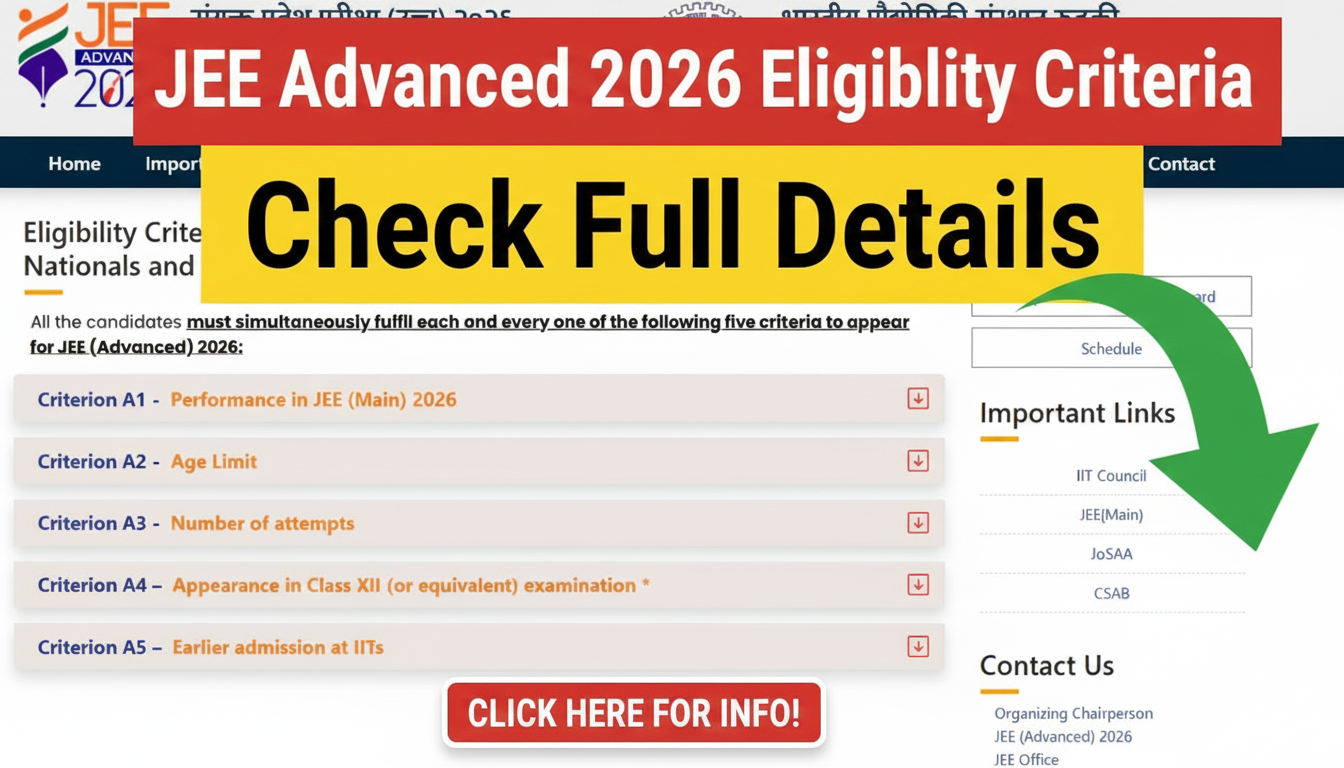
For thousands of engineering aspirants across India, JEE Advanced 2026 represents the final and most important step toward securing admission into the prestigious Indian Institutes of Technology (IITs). While preparing for the exam is crucial, understanding the eligibility criteria is equally important. Every year, many students miss their chance simply because they overlook one eligibility condition. This article explains the JEE Advanced 2026 eligibility criteria in a clear, simple, and human-written manner so that you know exactly where you stand.
The eligibility rules are designed to ensure fairness while maintaining the academic standards of IITs. Although the official notification for 2026 will be released later, the criteria generally follow a consistent structure based on previous years.
Performance in JEE Main 2026
The first and most important eligibility condition for JEE Advanced 2026 is performance in JEE Main 2026. Only the top-performing candidates from JEE Main are allowed to appear for JEE Advanced.
Typically, candidates must rank among the top 2.5 lakh students (across all categories combined) in the JEE Main Paper 1 (B.E./B.Tech). This includes category-wise reservations as per government norms. Simply appearing for JEE Main is not enough; qualifying within the required cutoff range is mandatory.
This rule ensures that only students with strong conceptual understanding and problem-solving skills move on to the advanced level.
Age Limit Criteria for JEE Advanced 2026
Age limit is another key factor in determining eligibility. Based on previous trends, candidates should be born on or after October 1, 2001 to be eligible for JEE Advanced 2026.
However, age relaxation is usually provided:
- SC, ST, and PwD candidates typically get a 5-year relaxation
- This means they are often eligible if born on or after October 1, 1996
Students should carefully verify their date of birth as mentioned in official documents, as discrepancies can lead to disqualification during counseling.
Number of Attempts Allowed
JEE Advanced is not an exam you can attempt unlimited times. Generally, a candidate is allowed to attempt JEE Advanced a maximum of two times in two consecutive years.
For example, if a student appears for JEE Advanced in 2025, they can attempt it again in 2026, but not beyond that. This rule applies strictly across all categories. Aspirants should plan their attempts wisely, keeping preparation and academic timelines in mind.
Educational Qualification Requirements
To be eligible for JEE Advanced 2026, candidates must have appeared for the Class 12 (or equivalent) examination in 2025 or 2026.
Students who appeared for their Class 12 exam in 2024 or earlier are generally not eligible. The qualifying examination must be recognized by a central or state board, and subjects usually include Physics, Chemistry, and Mathematics.
This criterion ensures that candidates have recent academic exposure to core science subjects essential for engineering studies.
Minimum Marks in Class 12 Examination
Apart from appearing in Class 12, candidates must also meet the minimum percentage or percentile requirements. Usually, students must:
- Be among the top 20 percentile of successful candidates in their respective board, or
- Secure at least 75% aggregate marks (65% for SC, ST, and PwD candidates)
The top 20 percentile rule varies from board to board, depending on overall performance trends. This condition emphasizes consistency in academic performance, not just entrance exam success.
Previous Admission to IITs
Candidates who have already been admitted to an IIT in the past are usually not eligible for JEE Advanced again, even if they withdrew later. However, candidates who were allocated a seat but did not report or did not accept the seat may still be eligible, depending on the specific year’s rules.
This condition prevents repeated attempts by students who have already secured an IIT seat, ensuring fair opportunities for new aspirants.
Foreign National Candidates Eligibility
Foreign nationals and OCI/PIO cardholders have a slightly different eligibility route. They are often exempted from JEE Main qualification, but they must still meet age and educational qualification requirements.
Seats for foreign nationals are limited, and admission is based on JEE Advanced performance. These candidates should carefully check separate guidelines released with the official brochure.
Documents Required to Prove Eligibility
During registration and counseling, candidates must provide valid documents to support their eligibility, including:
- Date of birth certificate or Class 10 certificate
- Class 12 marksheet or passing certificate
- Category certificate (if applicable)
- PwD certificate (if applicable)
Any mismatch or false information can result in cancellation of candidature, even at a later stage.
Why Understanding Eligibility Is Crucial
Many students focus entirely on preparation and ignore eligibility details until the last moment. This can lead to unnecessary stress or disqualification. Knowing the JEE Advanced 2026 eligibility criteria early helps students plan attempts, academic timelines, and backup options more effectively.
It also allows aspirants to stay confident, knowing they meet all requirements before investing time and effort into preparation.
Final Words
The JEE Advanced 2026 eligibility criteria play a decisive role in determining who can compete for admission to IITs. From JEE Main performance and age limits to attempt restrictions and Class 12 requirements, each condition must be fulfilled carefully. While minor details may change once the official notification is released, the overall framework remains largely consistent every year. Students are strongly advised to regularly check official updates and prepare with clarity and confidence, keeping both eligibility and preparation aligned for success.